window.statsig = new Statsig.StatsigClient('<CLIENT-SDK-KEY>', {/* USER */}, {/* OPTIONS */});
statsig.on('values_updated', function(evt) { // bind before init is called
  if(evt.status && evt.status === 'Ready') {
    window.dispatchEvent(new CustomEvent("statsig:ready", {
      detail: { statsig: statsig }
    }));
  }
});
await statsig.initializeAsync();
```text
#### Using statsig-js
```js
await statsig.initialize('<CLIENT-SDK-KEY>', '<USER-OBJECT>', {
  initCompletionCallback: function (duration, success, message) {
    window.dispatchEvent(new CustomEvent("statsig:ready", {
      detail: { statsig: statsig }
    }));
  }
});
```sql

### Step 2: Create new tag
<Frame>
  <img src="/images/gtm-create-tag.png" alt="GTM create new tag interface" />
</Frame>

### Step 3: Choose tag type
Choose "Custom HTML" for tag type, and paste [this GTM code](#gtm-code) (including script tag)

<Frame>
  <img src="/images/gtm-tag-configuration.png" alt="GTM tag configuration screen" />
</Frame>

### Step 4: Adjust fire options
Under Advanced Settings under "Tag Firing options", select "Once per page"

<Frame>
  <img src="/images/gtm-create-tag-options.png" alt="GTM tag firing options settings" />
</Frame>

### Step 5: Set Tag Trigger
Below the "Tag Configuration" section, set the Trigger to "Initialization - All Pages" Option.

<Frame>
  <img src="/images/gtm-tag-trigger.png" alt="GTM tag trigger configuration" />
</Frame>

### Step 6: Save tag and test
After saving the tag, and publishing your updated GTM tag, tracking will be done automatically without any additional configuration.
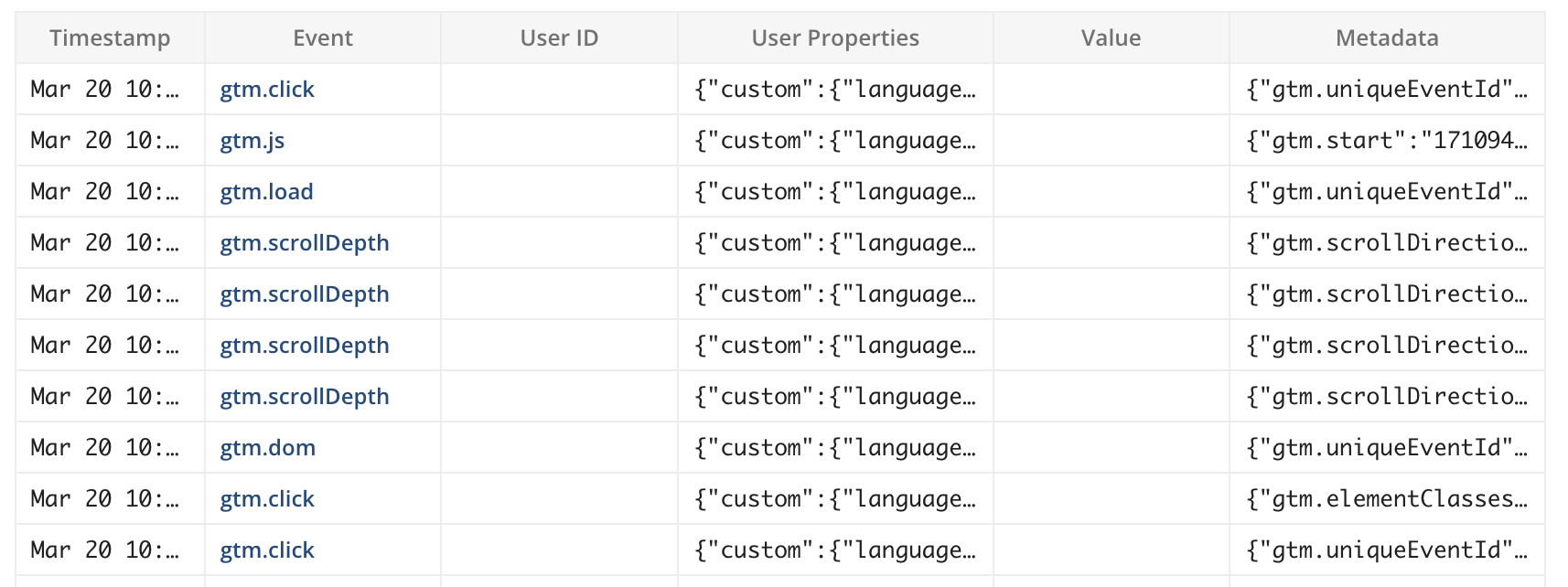
To debug the integration, you can set a local storage entry `debug_ss_gtm` with any value on your webpage. Now, you'll console log statements for each tracking call being dispatched to Statsig. You can also inspect your browser's network traffic to see events being tracked.

### GTM Code
<Info>
The code below assumes that the statsig client lives at `window.statsig`
</Info>
```html
<script type="text/javascript">
/* dataLayer helper */
(function(){
var f=/\[object (Boolean|Number|String|Function|Array|Date|RegExp|Arguments)\]/;function g(a){return null==a?String(a):(a=f.exec(Object.prototype.toString.call(Object(a))))?a[1].toLowerCase():"object"}function m(a,b){return Object.prototype.hasOwnProperty.call(Object(a),b)}function n(a){if(!a||"object"!=g(a)||a.nodeType||a==a.window)return!1;try{if(a.constructor&&!m(a,"constructor")&&!m(a.constructor.prototype,"isPrototypeOf"))return!1}catch(c){return!1}for(var b in a);return void 0===b||m(a,b)};function p(a,b){var c={},d=c;a=a.split(".");for(var e=0;e<a.length-1;e++)d=d[a[e]]={};d[a[a.length-1]]=b;return c}function q(a,b){var c=!a._clear,d;for(d in a)if(m(a,d)){var e=a[d];"array"===g(e)&&c?("array"===g(b[d])||(b[d]=[]),q(e,b[d])):n(e)&&c?(n(b[d])||(b[d]={}),q(e,b[d])):b[d]=e}delete b._clear};
function r(a,b,c){b=void 0===b?{}:b;"function"===typeof b?b={listener:b,listenToPast:void 0===c?!1:c,processNow:!0,commandProcessors:{}}:b={listener:b.listener||function(){},listenToPast:b.listenToPast||!1,processNow:void 0===b.processNow?!0:b.processNow,commandProcessors:b.commandProcessors||{}};this.a=a;this.l=b.listener;this.j=b.listenToPast;this.g=this.i=!1;this.c={};this.f=[];this.b=b.commandProcessors;this.h=u(this);var d=this.a.push,e=this;this.a.push=function(){var k=[].slice.call(arguments,
0),l=d.apply(e.a,k);v(e,k);return l};b.processNow&&this.process()}r.prototype.process=function(){this.registerProcessor("set",function(){var c={};1===arguments.length&&"object"===g(arguments[0])?c=arguments[0]:2===arguments.length&&"string"===g(arguments[0])&&(c=p(arguments[0],arguments[1]));return c});this.i=!0;for(var a=this.a.length,b=0;b<a;b++)v(this,[this.a[b]],!this.j)};r.prototype.get=function(a){var b=this.c;a=a.split(".");for(var c=0;c<a.length;c++){if(void 0===b[a[c]])return;b=b[a[c]]}return b};
r.prototype.flatten=function(){this.a.splice(0,this.a.length);this.a[0]={};q(this.c,this.a[0])};r.prototype.registerProcessor=function(a,b){a in this.b||(this.b[a]=[]);this.b[a].push(b)};
function v(a,b,c){c=void 0===c?!1:c;if(a.i&&(a.f.push.apply(a.f,b),!a.g))for(;0<a.f.length;){b=a.f.shift();if("array"===g(b))a:{var d=a.c;g(b[0]);for(var e=b[0].split("."),k=e.pop(),l=b.slice(1),h=0;h<e.length;h++){if(void 0===d[e[h]])break a;d=d[e[h]]}try{d[k].apply(d,l)}catch(w){}}else if("arguments"===g(b)){e=a;k=[];l=b[0];if(e.b[l])for(d=e.b[l].length,h=0;h<d;h++)k.push(e.b[l][h].apply(e.h,[].slice.call(b,1)));a.f.push.apply(a.f,k)}else if("function"==typeof b)try{b.call(a.h)}catch(w){}else if(n(b))for(var t in b)q(p(t,
b[t]),a.c);else continue;c||(a.g=!0,a.l(a.c,b),a.g=!1)}}r.prototype.registerProcessor=r.prototype.registerProcessor;r.prototype.flatten=r.prototype.flatten;r.prototype.get=r.prototype.get;r.prototype.process=r.prototype.process;window.DataLayerHelper=r;function u(a){return{set:function(b,c){q(p(b,c),a.c)},get:function(b){return a.get(b)}}};})();

window.StatsigLogger = (function () {

  var statsigInstance;
  var log = function () {
    if (typeof localStorage !== 'undefined' && typeof console !== 'undefined' && localStorage.getItem('debug_ss_gtm')) {
      console.log.apply(console, arguments);
    }
  };

  var handleGTMMessage = function (model, message) {
    if (typeof message === 'object' && typeof message.event === 'string') {
      var metadata = {};
      for (var prop in message) {
          if(!(message[prop] instanceof HTMLElement) && typeof(message[prop]) !== 'object') {
            metadata[prop] = message[prop];
          }
      }
      log('++ handleGTMMessage', message.event, message.conversionValue || null, metadata);
      statsigInstance.logEvent(message.event, message.conversionValue || null, metadata);
    }
    else {
      log('++ handleGTMMessage / skip');
    }
  }

  var init = function(condition) {
    log('+++ Statsig:ready ->', condition);
    // this may have past messages that haven't yet been handled
    var globalGTMListener = new DataLayerHelper(dataLayer, {
      listener: handleGTMMessage,
      listenToPast: true,
    });
  }

  var clientReady = false;
  try {
    // The code below assumes that the statsig client lives at `window.statsig`
    clientReady = (statsig && statsig.getClientX && statsig.getClientX().ready) || statsig.loadingStatus === 'Ready';
  } catch(err) { }

  if(clientReady) {
    // if client is already initialized, proceed
    statsigInstance = statsig;
    init('pre-GTM');
  }
  else {
    // otherwise wait for statsig
    window.addEventListener('statsig:ready', function(evt) {
      statsigInstance = evt.detail.statsig;
      init('post-GTM');
    });
  }

})();
</script>
```text

## Outbound Integration (GTM Data is enriched with Statsig test assignments)

This pattern will allow you to enrich your GTM `dataLayer` with experiment assignment information.

<Frame>
  <img src="/images/gtm-outbound.png" alt="gtm datalayer outbound" />
</Frame>

Prior to your Statsig `initialize` call, you should bind an EventEmitter listener that captures the assigned experiment name and test group, and push it into the `dataLayer` as follows. Note that the argument passed to the callback contains rich context about the assignment. Please modify the GTM `dataLayer` properties to your liking.

```js
// use event emitter to listen for experiment assignments
statsigClient.on("experiment_evaluation", function(evt) {
  window.dataLayer.push({
    'event': 'experiment_viewed',
    'experiment_name': evt.experiment.name,
    'variant_name': evt.experiment.groupName
  })
});

await statsigClient.initializeAsync();